

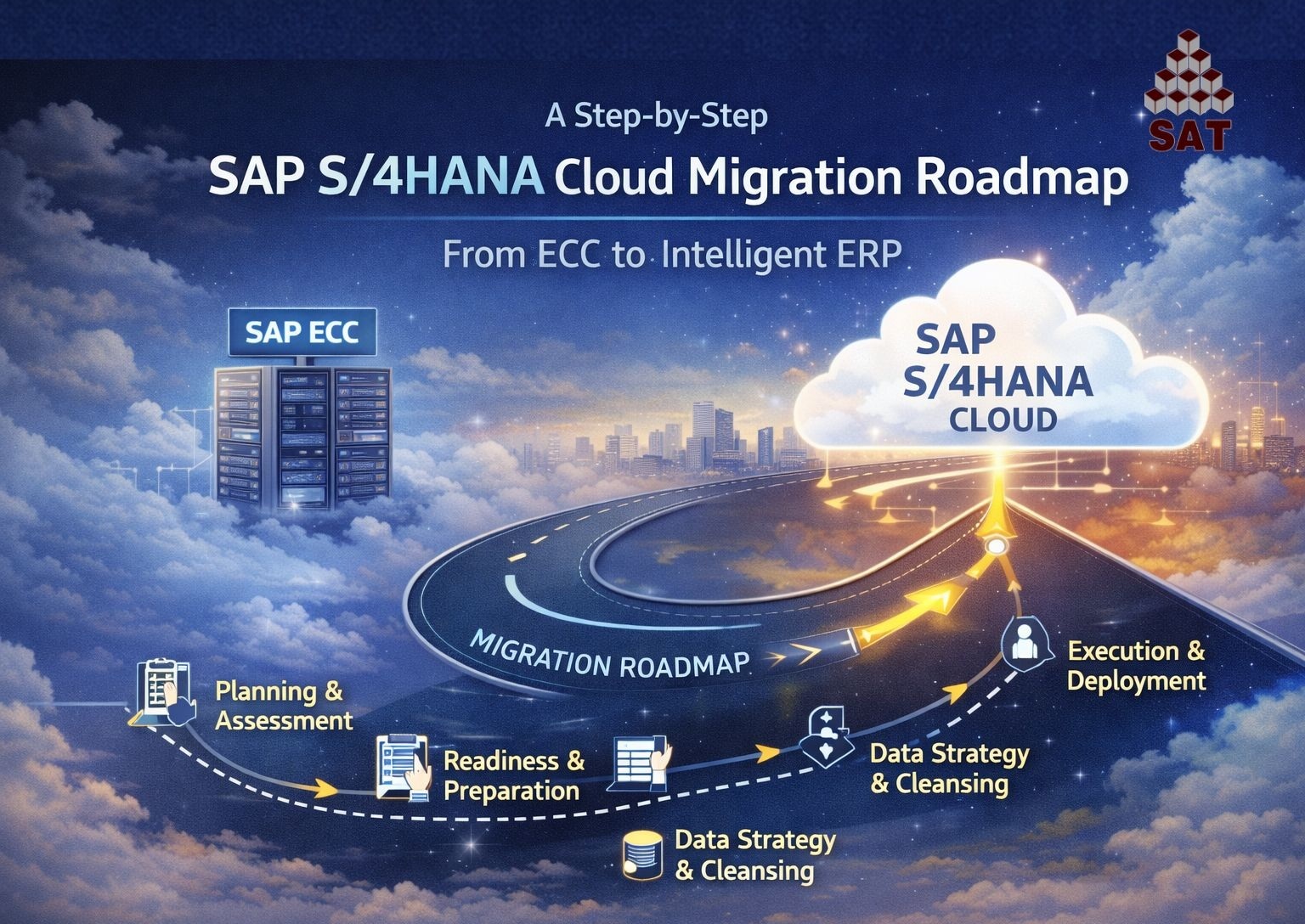
As enterprises move forward in their digital transformation journey, migrating from SAP ECC to SAP S/4HANA Cloud has become a strategic priority rather than an optional upgrade. With SAP’s roadmap clearly signaling the end of ECC support, organizations must act decisively to modernize their ERP landscape.
However, SAP S/4HANA Cloud migration is not just a technical conversion—it is a business transformation initiative that impacts processes, people, and performance.
Why a Structured Migration Roadmap Matters
Many SAPECC migrations fail or face delays due to:
- • Poor system readiness
- • Excessive customization
- • Weak data governance
- • Lack of change management
A well-defined roadmap minimizes risk, controls costs, and ensures business continuity - especially for industries such as Chemicals, Metals & Mining, Building Materials, and Mill Products, where operational downtime is not an option.
This is where experienced SAP partners like SAT InfoTech play a critical role.
Step 1: SAP ECC System Assessment & Readiness Check
The migration journey begins with a comprehensive assessment of the existing SAP ECC environment.
Key Activities
- • ECC version and add-on analysis
- • Custom code inventory and relevance check
- • Data quality and volume assessment
- • Integration and interface review
- • Business process complexity evaluation
This phase identifies technical debt and defines what should be retained, retired, or redesigned.
Step 2: Define the Right Migration Approach
Choosing the correct migration approach is critical to long-term success.
Common Migration Approaches
- • Greenfield – Fresh implementation with process redesign
- • Brownfield – System conversion with minimal changes
- • Selective Transformation – Hybrid approach combining both
Each approach suits different business scenarios:
- • Greenfield works well for process standardization
- • Brownfield suits stable ECC environments
- • Selective transformation is ideal for complex enterprises
At SAT InfoTech, we help organizations align migration strategy with business goals - not just technical feasibility.
Step 3: Choose Public or Private SAP S/4HANA Cloud
The next step is selecting the right SAP S/4HANA Cloud deployment model.
Public Cloud
- • Faster implementation
- • Lower total cost of ownership
- • Standard SAP best practices
Private Cloud
• Higher customization
- • Supports complex industry processes
- • Greater system control
Industries such as Metals & Mining and Chemicals often prefer Private Cloud, while fast-growing organizations may benefit from Public Cloud.
Step 4: Data Cleansing & Preparation
Data is the foundation of intelligent ERP. Migrating poor-quality data leads to poor out comes.
Best Practices
- • Remove obsolete master and transactional data
- • Harmonize data structures
- • Validate financial and inventory data
- • Define data ownership and governance
SAPS/4HANA Cloud thrives on clean, real-time data, enabling embedded analytics and AI-driven insights.
Step 5: Custom Code Optimization & Core Clean Strategy
SAPS/4HANA Cloud promotes a “Keep the Core Clean” philosophy.
- What This Means
- • Minimize custom code inside ERP core
- • Replace customizations with standard SAP processes
- • Move enhancements to SAP BTP extensions
This approach ensures:
- • Easier upgrades
- • Faster innovation
- • Reduced long-term maintenance costs
Step 6: Business Process Redesign &Fit-to-Standard
SAPS/4HANA Cloud offers preconfigured industry best practices. Instead of replicating old processes, organizations should embrace fit-to-standard.
Benefits
- • Streamlined workflows
- • Reduced manual intervention
- • Improved compliance and transparency
This step is especially impactful for:
- • Production planning in Mill Products
- • Asset management in Metals & Mining
- • Batch traceability in Chemicals
Step 7: System Configuration, Integration &Testing
This phase brings the new ERP system to life.
Key Activities
- • SAP S/4HANA Cloud configuration
- • Integration with third-party systems
- • SAP BTP-based extensions setup
- • Functional, integration, and UAT testing
Robust testing ensures business continuity and avoids post-go-live surprises.
Step 8: Change Management & User Enablement
Technology alone does not guarantee success-people do.
Effective Change Management Includes
- • Role-based SAP Fiori training
- • Early user involvement
- • Clear communication of process changes
- • Adoption-focused KPIs
User-friendly SAP Fiori interfaces significantly improve productivity when supported by proper training.
Step 9: Go-Live & Post-Go-Live Support
A successful go-live is only the beginning.
Post-Go-Live Focus Areas
- • Hypercare support
- • Performance monitoring
- • Issue resolution
- • Continuous process optimization
SAT InfoTech provides Application Management Services (AMS) to ensure stability, scalability, and continuous improvement.
Step 10: Innovate with SAP BTP, AI & Automation
After migration, organizations can unlock the true power of SAP S/4HANA Cloud by extending it with:
- • AI-driven automation
- • Predictive analytics
- • Industry-specific BTP extensions
Examples include:
- • India E-Invoicing & E-Way Bill automation
- • WhatsApp Conversational AI
- • Automated Gate Entry Systems
Industry Impact of a Successful Migration
Chemicals
- • Regulatory compliance
- • Batch traceability
- • Quality and safety management
Metals & Mining
- • Asset lifecycle visibility
- • Predictive maintenance
- • Production optimization
Building Materials & Mill Products
- • Cost control
- • High-volume planning
- • End-to-end supply chain integration
SAPS/4HANA Cloud enables real-time decision-making across the value chain.
Why Choose SAT InfoTech for SAP S/4HANA Cloud Migration?
SAT InfoTech combines:
- • Deep SAP ERP expertise
- • Industry-focused migration experience
- • Proven methodologies
- • SAP BTP-driven innovation
From ECC assessment to post-go-live optimization, we act as a long-term digital transformation partner, not just an implementation vendor.
Final Thoughts
Migrating from SAP ECC to SAP S/4HANA Cloud is a strategic transformation journey-one that requires planning, expertise, and the right partner.
By following a structured roadmap, organizations can reduce risk, accelerate value realization, and build a resilient ERP foundation for the future.
Ready to start your SAP S/4HANA Cloud migration journey?
SAT InfoTech is here to guide you—every step of the way.

Date
Categories
-1.jpg?width=352&name=Helping%20You%20Leverage%20the%20Power%20of%20SAP%E2%80%99s%20AI%20Capabilities%20(1)-1.jpg)
%20post%201200%20x%20627%20pixels%20(2).jpg?width=352&name=LinkedIn%20landscape%20(horizontal)%20post%201200%20x%20627%20pixels%20(2).jpg)

%20post%201200%20x%20627%20pixels%20(5).jpg?width=352&name=LinkedIn%20landscape%20(horizontal)%20post%201200%20x%20627%20pixels%20(5).jpg)